Explore the Crypto Valuation Radar →
Hyperliquid is worth approximately $21 billion. So is Kraken, according to its latest private financing valuation. Kraken’s parent company, Payward, generated $508 million in adjusted revenue during Q2 2026. Hyperliquid generated approximately $174 million in protocol revenue during Q3.
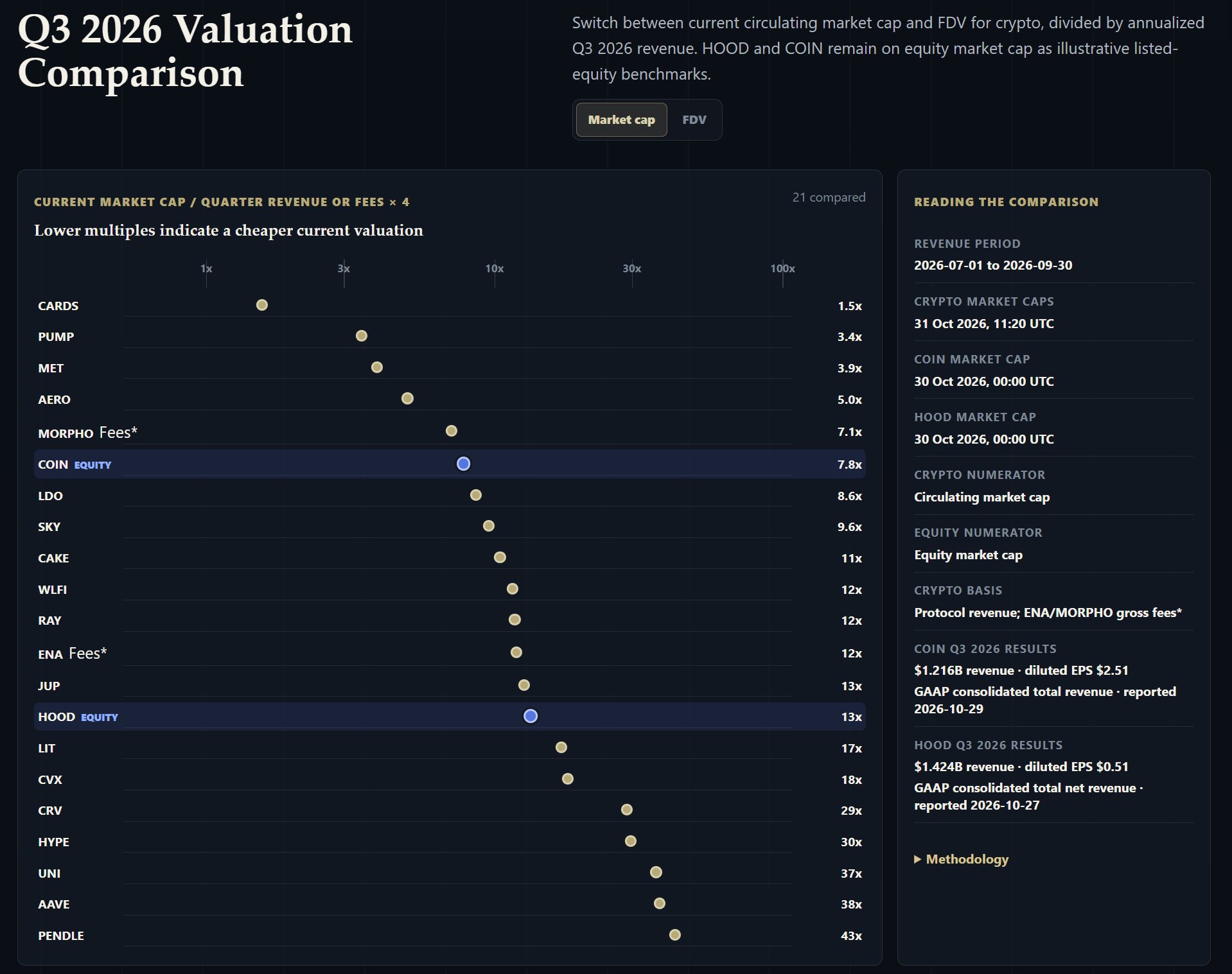
Yet the market values HYPE at roughly 30× annualized quarterly revenue, compared with approximately 10× for Payward.
Coinbase trades near 8×. Intercontinental Exchange, owner of the NYSE, trades near 9×. Nasdaq trades near 10×. CME, one of the world’s most profitable exchange businesses, trades near 16×.
Does Hyperliquid deserve a premium to businesses that have spent decades building their exchanges, regulatory relationships, clearing infrastructure, and institutional franchises?
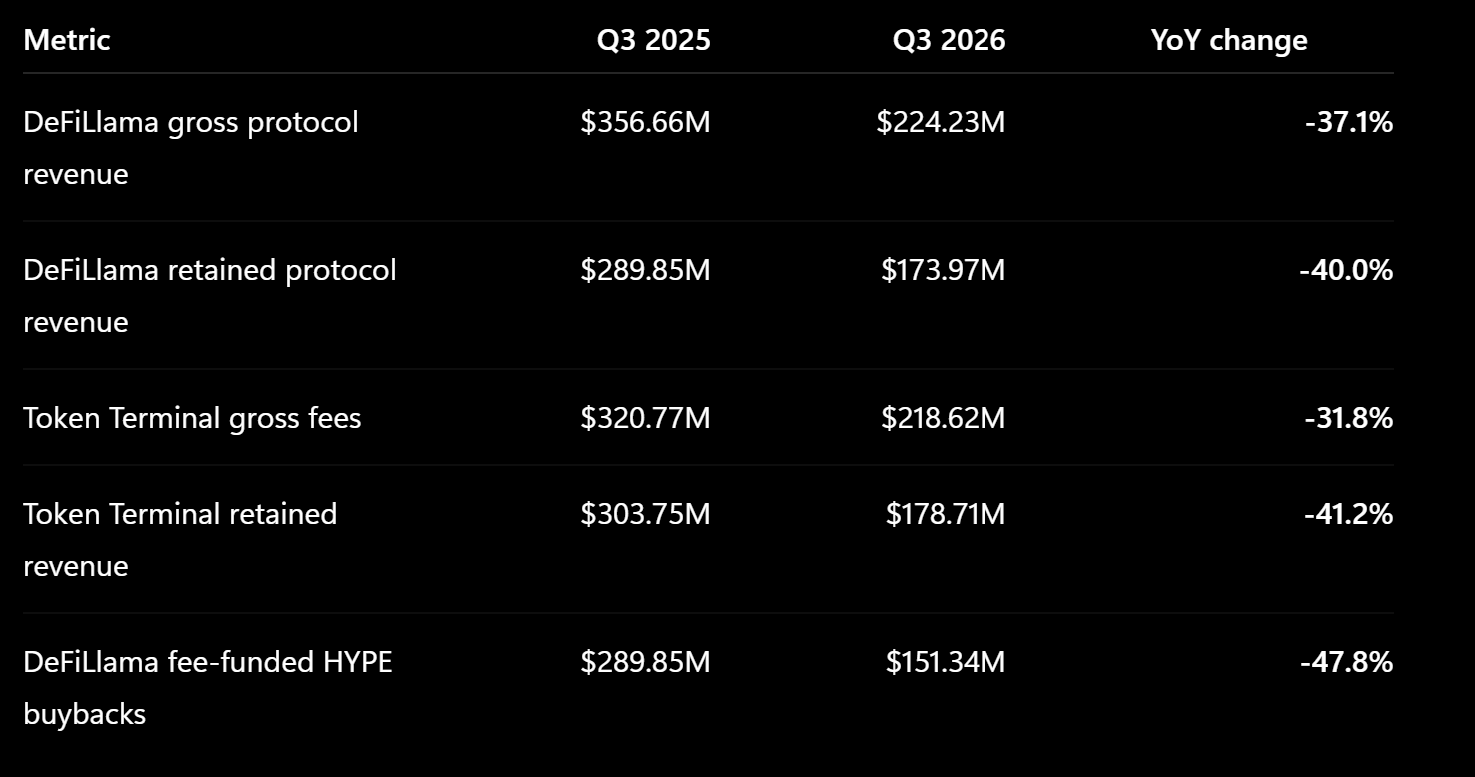
Red flag: Hyperliquid’s Q3 revenue is down 40% YoY
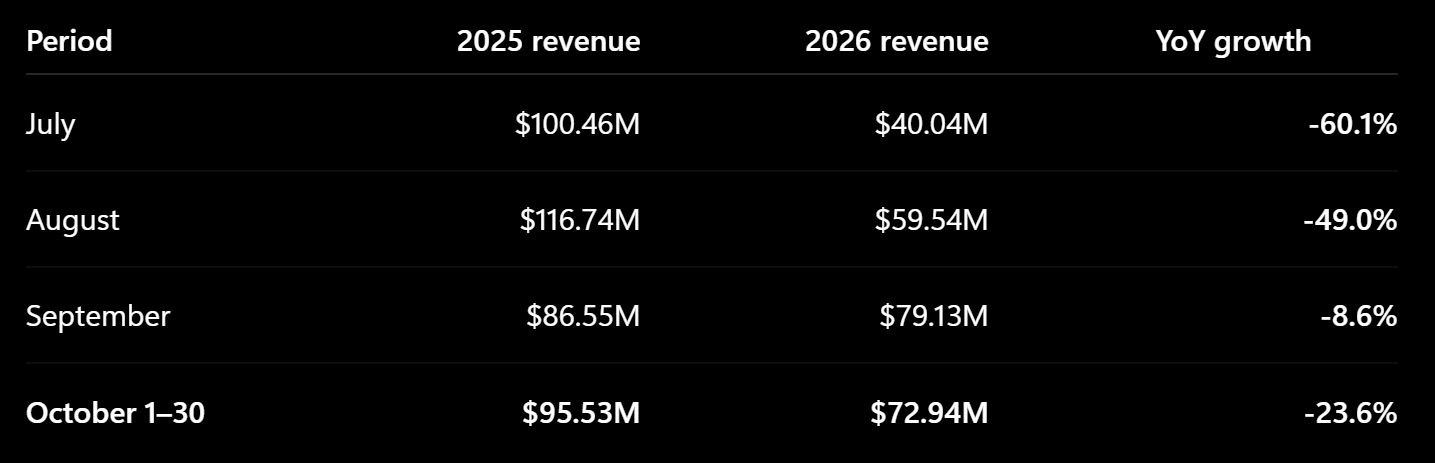
Hyperliquid’s recent monthly performance looks encouraging. Seems that traders are liking the ability to trade OIL on a weekend.
Revenue rose from $38.4 million in July to $74.2 million in September. For Q3 overall, revenue increased approximately 17% compared with Q2 2026. However, that did not help to avoid a massive 40% year-over-year drop.
Crypto exchanges are cyclical. Trading activity depends on volatility, leverage, market participation, competitive pricing, and speculative appetite. A single quarterly comparison can be misleading.
But it creates a high hurdle.
A 30× revenue valuation is much easier to defend if earnings are growing 50% annually than if revenue is contracting 40%.
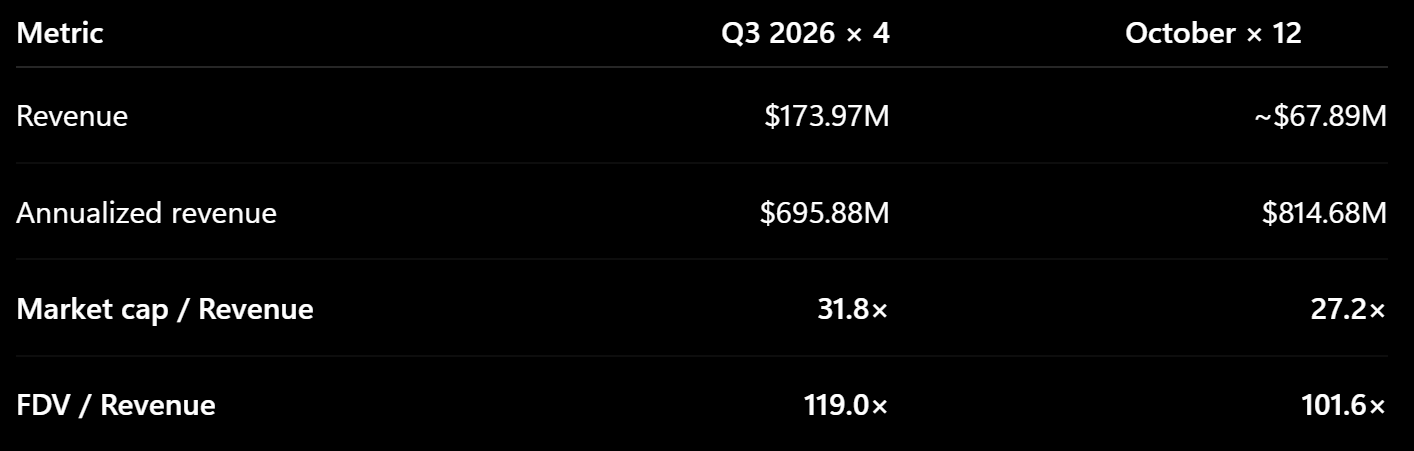
Hyperliquid’s valuation therefore depends less on the last reported quarter than on whether its next phase of growth will prove durable. October 2026 is NOT helping to say that the corner been turned. So if we use a popular metric like ARR and multiply Oct26 revenues * 12 - still get 27x multiple. And to be clear - we are using the circulating mcap - if use the FDV multiples spike to 100+
Sources & context
Source: Token Terminal, Hyperliquid retained protocol revenue. October compares identical 30-day periods. The latest complete observation is October 30, 2026.
What do publicly listed exchanges actually trade at?
To put the valuation in context, I compared Hyperliquid with major exchange operators and brokerage platforms using their latest Q3 2026 results.
For consistency, the multiple is calculated as:
Current market capitalization / (Q3 reported revenue × 4).
These are annualized-quarter revenue multiples, not trailing-12-month P/S ratios or EV/revenue multiples.
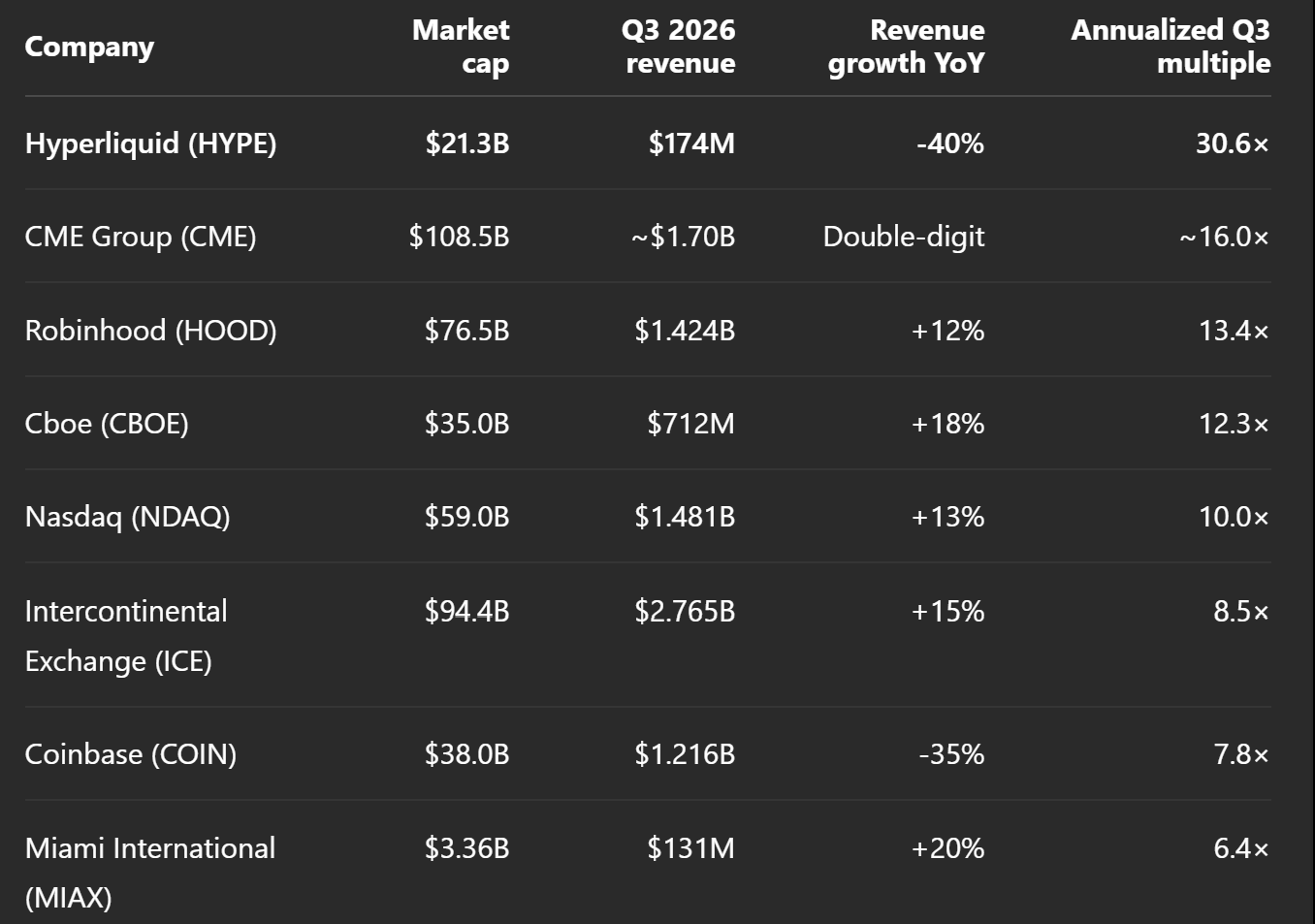
Hyperliquid trades at approximately:
- 3.9× Coinbase’s revenue multiple
- 3.6× ICE’s revenue multiple
- 3.1× Nasdaq’s revenue multiple
- 2.5× Cboe’s revenue multiple
- 1.9× CME’s revenue multiple
These are comparisons of valuation ratios, not relative fair-value estimates. Differences in margins, capital requirements, balance sheets, tax treatment and revenue recognition are substantial.
Nevertheless, the valuation premium is too large to ignore.
The comparison becomes even more interesting internationally
Deutsche Börse, which operates major European exchanges and post-trade infrastructure, trades at approximately 8.8× annualized Q3 net revenue, including treasury income.
London Stock Exchange Group trades at approximately 4.7× annualized Q3 total income excluding recoveries.
These are diversified infrastructure and data businesses, not pure cryptocurrency exchanges. Their revenue definitions also differ. But they reinforce the same point: the public market generally assigns substantially lower revenue multiples to established exchange infrastructure than it currently assigns to HYPE.
Deutsche Börse’s Q3 2026 net revenue was €1.633 billion, while LSEG reported £2.407 billion of total income excluding recoveries. Each multiple uses market capitalization and revenue in the same reporting currency.
Kraken may be Hyperliquid’s most revealing comparison
Traditional exchanges provide useful valuation benchmarks, but Kraken offers something closer to a direct comparison.
Payward, Kraken’s parent company, reported the following Q2 2026 results:
Adjusted revenue: $508 million, up 17% year over year.
Adjusted EBITDA: $23 million.
Total platform transaction volume: $310 billion.
Assets on platform: $40 billion.
Notably, approximately 60% of Payward’s revenue came from asset-based and other services rather than traditional transaction fees.
In September, Nasdaq agreed to invest $100 million in Payward at a reportedly $21 billion valuation.
That implies approximately:
$21 billion / ($508 million × 4) = 10.3× annualized adjusted revenue.
Compare that with HYPE.
The two carry similar headline valuations, but Payward currently generates almost three times as much quarterly revenue on its reported adjusted basis.
Kraken also possesses established customer relationships, regulatory permissions, custody infrastructure, fiat connectivity, and expanding capabilities in derivatives and tokenized securities.
Hyperliquid has very different strengths: an onchain trading architecture, its crypto-native distribution, substantial perpetual-futures liquidity, and a direct mechanism for channeling protocol economics toward HYPE.
Neither is a perfect substitute for the other.
Payward’s $21 billion is also a reported private financing valuation, not the continuously traded market value of ordinary public shares. The financing terms may differ from those of common equity.
Still, if Hyperliquid were preparing an IPO, Payward would be among the first companies public-market investors would examine.
And it would be difficult to ignore the revenue gap.
Sources & context
Sources: Payward’s Q2 financial disclosure, Nasdaq’s September investment announcement, and reporting on the financing valuation.
The other listed crypto exchanges provide a useful reality check
The publicly traded crypto-exchange universe has become more substantial.
Coinbase is no longer the only relevant listed benchmark.
Bullish, Gemini and eToro provide additional reference points, although their most recently published results are for Q2 2026, rather than Q3.
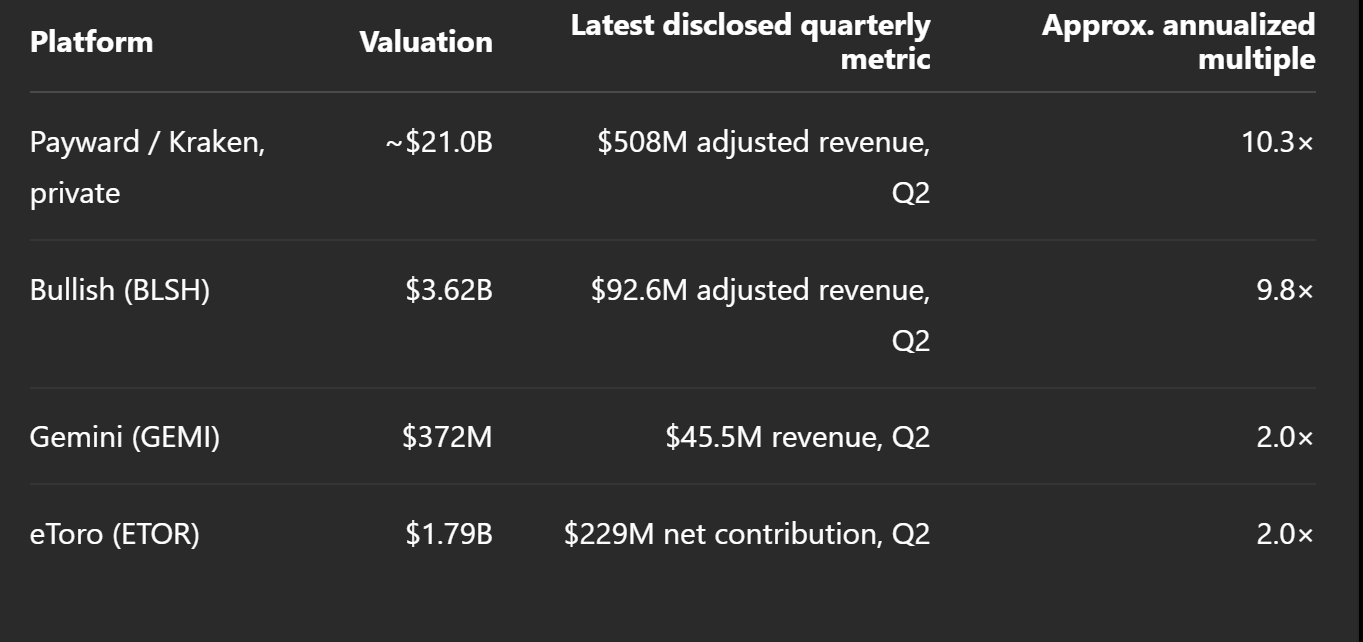
These metrics are not fully comparable.
Bullish reports adjusted revenue because its accounting for digital-asset transactions can produce very large gross sales figures that do not represent exchange fee income.
eToro’s net contribution is a company-specific profitability-related revenue measure rather than consolidated GAAP revenue.
Gemini’s much lower multiple reflects a very different financial and risk profile, including significant operating losses.
Bullish has scheduled its Q3 results for November 18, while Gemini and eToro are also due to report in November.
The important conclusion is not that every crypto exchange should trade at the same multiple.
It is that even the more relevant publicly traded crypto platforms provide little direct support for a 30× revenue valuation without exceptional growth or profitability assumptions.
Sources & context
Sources: Payward, Bullish, Gemini and eToro company disclosures; October 30 market capitalizations.
What makes a great exchange worth a premium?
The traditional exchange business has one especially attractive characteristic.
Once sufficient liquidity becomes concentrated in a marketplace, participants face strong incentives to remain there.
A new competitor may reproduce an exchange’s technology. Reproducing its liquidity, order flow and trading relationships is much harder.
This is the classic exchange network effect.
Traders prefer markets with tighter spreads and greater depth.
Market makers prefer markets with more active traders.
More participants attract additional products, which attract more traders.
The result can be a self-reinforcing competitive advantage.
But not all exchange moats are equally durable.
Consider three traditional operators.
CME benefits from deeply established institutional liquidity, benchmark contracts, margin efficiencies, clearing arrangements, and a large network of hedgers and market makers. Reproducing its software would not recreate the commercial ecosystem surrounding its interest-rate or commodity futures.
ICE combines exchange infrastructure, clearing, proprietary data, financial-market connectivity, and the NYSE. Its competitive position depends on relationships and regulatory infrastructure accumulated over decades.
Cboe possesses something particularly valuable: exclusive rights supporting its SPX and VIX product franchises. In October, Cboe announced that its exclusive S&P license had been extended through 2051.
That is a genuine contractual moat.
A competitor cannot simply launch identical licensed SPX products and expect to compete away the franchise.
This distinction matters for Hyperliquid.
The value of a trading platform is not determined by whether another company can copy its code. It is determined by how easily competitors can reproduce the economics generated by that code.
What is Hyperliquid’s actual moat?
Hyperliquid has several competitive advantages that deserve serious consideration.
Liquidity is the strongest
As of October 29, DeFiLlama tracked approximately $7.87 billion of open interest on Hyperliquid, representing roughly 57% of open interest across the perpetual DEX platforms in its dataset.
Over the preceding 30 days, Hyperliquid accounted for approximately $207 billion of the $624 billion in reported perpetual DEX volume, or around 33%.
These figures do not represent a 57% share of the entire global cryptocurrency derivatives market. Large centralized venues remain outside this comparison.
Nevertheless, Hyperliquid’s dominance within onchain perpetuals is substantial.
Competitors such as Aster, Lighter and Variational have developed meaningful trading activity, but Hyperliquid remains the reference venue for a large segment of the market.
This is difficult to reproduce in 12 months.
A new exchange can launch a technically impressive order book in weeks or months.
It cannot instantly replicate billions of dollars in established open interest, the corresponding risk-management ecosystem, or years of relationships between traders, market makers and developers.
This is Hyperliquid’s clearest economic moat.
Execution infrastructure is a meaningful advantage
Hyperliquid’s HyperCore architecture integrates order matching, margining and liquidations directly into its blockchain execution environment.
The project’s technical documentation reports median end-to-end latency of approximately 0.2 seconds for geographically colocated clients and capacity of approximately 200,000 orders per second.
These are operator-reported capabilities, not independent guarantees of performance under every market condition.
The more important achievement is combining a high-performance trading experience with an onchain system that other applications can build upon.
This took considerable engineering effort.
Nevertheless, technology is not an indefinitely protected moat.
Competitors can develop similar architectures, improve execution speed, introduce competing margin systems, or subsidize liquidity.
Hyperliquid’s technical advantage matters most because it already supports an operating marketplace with substantial activity.
HIP-3 creates a potentially valuable distribution moat
HIP-3 allows third-party developers to create perpetual-futures markets using Hyperliquid’s underlying infrastructure.
This changes the platform’s competitive proposition.
Hyperliquid is not merely trying to attract traders to a fixed catalog of cryptocurrency contracts.
It is also attempting to become the infrastructure on which other developers build trading businesses.
A successful ecosystem could attract specialized operators in equities, commodities, foreign exchange and other assets.
Each additional successful market may increase demand for the same execution environment, liquidity infrastructure and HYPE-related staking mechanisms.
The potential advantage resembles an exchange infrastructure platform rather than a single trading application.
But there is a critical distinction between ecosystem growth and token-holder monetization.
A new market can generate substantial volume while contributing relatively little revenue to the underlying protocol.
That risk is particularly relevant because HIP-3 includes flexible fee-sharing arrangements and a growth mode designed to reduce trading fees by at least 90% for qualifying markets.
Expanding volume is not necessarily equivalent to expanding revenue.
The valuation case therefore depends on how much economic value Hyperliquid retains from its ecosystem, not simply on how many markets developers launch.
The October 29 ICE announcement changes the investment case
One of the most important developments for Hyperliquid occurred just two days ago.
On October 29, Intercontinental Exchange announced a definitive agreement with Trade[XYZ] to pursue a regulated U.S. market for perpetual futures built on Hyperliquid technology.
Under the proposed arrangement, ICE will operate the regulated markets and establish a dedicated clearing structure, subject to regulatory approvals.
ICE is also making a strategic investment in Trade[XYZ].
The announcement matters for several reasons.
First, it provides meaningful validation of Hyperliquid’s infrastructure.
ICE already operates some of the world’s most important financial-market systems. It does not need a decentralized trading platform merely to demonstrate that perpetual contracts can be created.
Its decision to work with Trade[XYZ] suggests that Hyperliquid offers functionality, developer relationships, or market access worth incorporating into a new business.
Second, ICE could help connect perpetual trading infrastructure with institutional-grade compliance, clearing and distribution.
Third, it potentially expands Hyperliquid’s addressable market beyond offshore crypto-native traders.
These are material positives.
But the announcement should not be treated as a direct financial contract between ICE and HYPE holders.
ICE’s announced investment is in Trade[XYZ], not an acquisition of HYPE or an investment in Hyperliquid equity. If ICE and Druckenmiller believe Hyperliquid’s infrastructure is valuable enough to invest in Trade[XYZ], why are they investing in the application-layer business rather than simply acquiring HYPE? Galaxy Research specifically notes that it remains uncertain whether activity on the U.S. venue will generate the same protocol fees that currently benefit HYPE holders.
The proposed U.S. market remains subject to regulatory approval.
Its market and clearing structure would be distinct from ICE’s existing institutional franchise.
The announcement does not establish how much incremental volume would flow through existing Hyperliquid order books, whether the regulated structure would generate comparable protocol fees, or how much additional HYPE would ultimately be purchased or burned.
That remains to be demonstrated.
For HYPE investors, the crucial question is not simply whether the market launches.
It is whether the new market’s economics accrue to HYPE holders.
The distinction between technology adoption and token value capture may become the most important question in Hyperliquid’s next phase.
Sources & context
Source: ICE’s October 29 announcement.
Does HYPE deserve a premium?
The strongest argument for a premium is that Hyperliquid may become something larger than a cryptocurrency exchange.
Its potential addressable market includes perpetual contracts on traditional financial assets, infrastructure used by third-party market operators, and applications built around its trading and settlement systems.
If the platform succeeds, its long-term revenue opportunity could be much larger than today’s cryptocurrency derivatives fees suggest.
There is also a potentially attractive token-economic mechanism.
A substantial proportion of protocol-generated value is directed toward HYPE purchases and burns.
Unlike a traditional company, Hyperliquid does not need to fund an extensive corporate organization, regulatory reporting infrastructure and public-company shareholder distributions before value reaches the token mechanism.
That may support very high economic efficiency.
But it would be a mistake to treat protocol revenue as equivalent to a listed company’s earnings.
HYPE holders do not own ordinary shares in a corporation with legally enforceable residual claims on its profits and assets.
The protocol’s reported financial measures do not provide a full set of audited corporate operating costs, liabilities, tax expenses and free cash flows.
And importantly, token buybacks do not necessarily translate into reduced circulating supply if unlocks and other distributions introduce additional tokens.
At approximately $21.3 billion of circulating market capitalization, HYPE’s $696 million annualized holder-revenue figure represents a 3.3% implied annual flow yield.
Using the narrower $605 million annualized fee-derived buyback measure gives approximately 2.8%.
Neither is a dividend yield, and neither should be interpreted as guaranteed shareholder earnings.
Those yields must be weighed against the risk of dilution and changes in future protocol economics.
CoinGecko currently reports a fully diluted valuation exceeding $80 billion, considerably higher than HYPE’s circulating market capitalization.
This does not mean that all remaining tokens will enter circulation immediately.
It does mean that the path of future supply is central to any long-term valuation.
The reported November contributor-unlock schedule deserves particular scrutiny. Published token-unlock trackers differ in how they classify scheduled releases, so investors should verify actual transfers and circulating-supply changes rather than assume that every scheduled unlock becomes immediate selling.
What if Hyperliquid were actually a listed stock?
This is where the comparison becomes most revealing.
Imagine that Hyperliquid were reorganized as a publicly traded company.
Assume the company retained the economic equivalent of today’s $696 million annualized protocol revenue.
To make the comparison meaningful, we would need to estimate actual operating expenses, taxes, and earnings attributable to shareholders.
Those figures are not available in the same way they are for Coinbase or CME.
We therefore need explicit assumptions.
Consider an illustrative case:
Annual revenue: $696 million.
Operating margin: 70%.
Effective tax rate: 25%.
Normalized net income: approximately $365 million.
Valuation: 30× normalized earnings.
That would imply an equity valuation of approximately:
$365 million × 30 = $11 billion.
A 30× earnings multiple is not especially conservative for a business expected to deliver strong long-term growth.
In fact, CME and Cboe currently trade closer to the mid-20s on trailing earnings, despite their more established franchises.
Using a 60% to 75% operating-margin range and 25× to 35× earnings, an unchanged-revenue Hyperliquid would produce an indicative equity valuation of approximately $8 billion to $14 billion.
That is materially below HYPE’s current circulating market capitalization.
But the exercise is hypothetical.
It assumes a taxable equity business with legally enforceable shareholder claims, rather than a token with protocol-directed economic benefits.
It also ignores any additional value from non-trading products, balance-sheet assets, or future token supply.
The calculation is not a HYPE price target. It shows what the current revenue stream might support under conventional equity-market assumptions.
What growth would justify today’s valuation?
At a $21.3 billion valuation, the critical issue is how quickly Hyperliquid can grow its economics.
Suppose a listed Hyperliquid could sustain:
- A 70% operating margin.
- A 25% effective tax rate.
- A 30× earnings multiple.
Under those assumptions, supporting a $21.3 billion valuation would require approximately $1.35 billion in annual revenue.
That is almost 94% above the current Q3 2026 annualized revenue base.
In other words, even granting Hyperliquid substantial profitability and a premium earnings multiple, today’s circulating market capitalization implies very significant growth from the recent quarterly run rate.
To illustrate the sensitivity, consider three hypothetical 2027 scenarios.
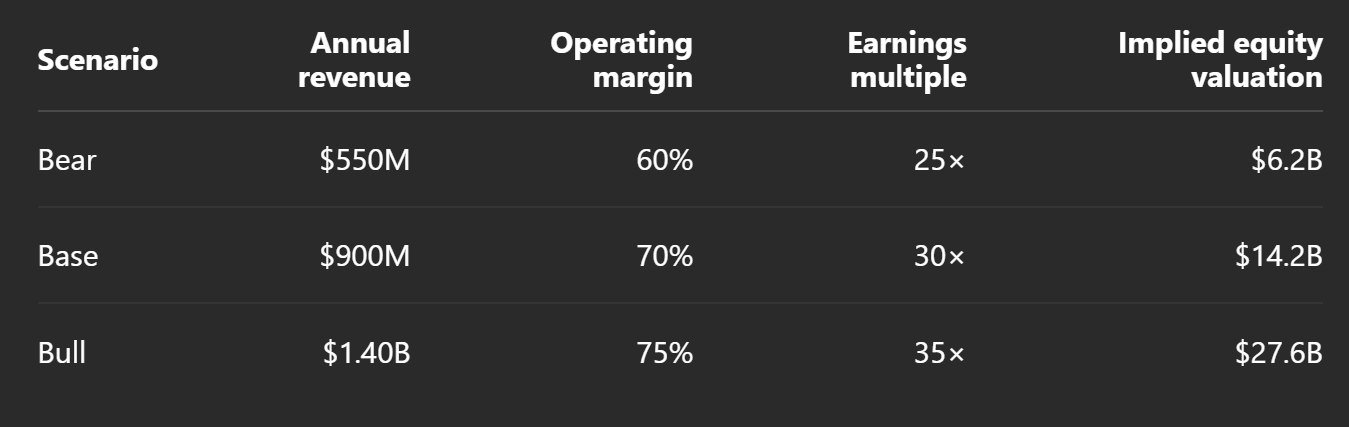
All scenarios assume a 25% effective tax rate. They are illustrative operating cases, not probability-weighted forecasts or token price targets.
The differences are enormous.
The bear case represents persistent competitive pressure and weaker monetization.
The base case assumes revenue recovers meaningfully and the exchange maintains unusually attractive profitability.
The bull case requires roughly doubling the Q3 2026 annualized revenue run rate while maintaining exceptional margins and receiving a premium market valuation.
The ICE and Trade[XYZ] initiative, continued expansion of HIP-3, and increasing adoption of onchain perpetuals could help produce a bull outcome.
But none of those developments has yet demonstrated that level of incremental annual revenue.
The current valuation is not simply pricing an excellent exchange. It is pricing an excellent exchange plus substantial future growth.
What could invalidate the bullish thesis?
For me, the most important risk is not that another exchange copies Hyperliquid’s technology.
The greater risk is that competitors reproduce enough of the trading experience to reduce its ability to monetize liquidity.
Aster, Lighter, Variational and other competitors do not need to displace Hyperliquid completely.
They only need to attract sufficient market makers, active traders or specialized products to compress fees and reduce Hyperliquid’s economics.
This matters because trading fees are a relatively small percentage of transaction value.
A modest reduction in the effective fee rate can translate into a substantial decline in revenue.
Hyperliquid could therefore continue reporting strong perpetual trading volume and high open interest while generating less value per dollar traded.
That would challenge the argument for a premium revenue multiple.
The second risk is regulatory.
The ICE agreement illustrates the potential value of regulated distribution.
It also highlights a competitive advantage already possessed by traditional exchanges and brokers: established permissions, compliance systems, and clearing relationships.
Hyperliquid must demonstrate that operating through regulated partners can expand its economic opportunity without moving the most valuable activity into structures that bypass its existing token value-capture mechanism.
The third risk is supply.
For a conventional public company, investors can estimate share dilution through disclosures, share-based compensation, option exercises, and repurchase authorizations.
For HYPE, investors need to monitor token unlocks, treasury allocations, staking rewards, and burns.
A growing protocol does not automatically produce a shrinking tradable token supply.
And a fourth risk is market structure.
A derivatives exchange that expands into equities, commodities and other real-world assets must manage increasingly complicated oracle, liquidation, market-hours and cross-asset risks.
Performance under ordinary market conditions does not establish resilience under an extreme stress event.
What would change my valuation?
I would focus on five developments over the next 12 months.
First, genuine revenue growth.
A sustained recovery toward $1 billion or more in annualized protocol revenue would materially improve the valuation argument.
The key metric is retained revenue, not headline transaction volume.
Second, sustained competitive share.
Hyperliquid’s liquidity position is currently its strongest moat.
If it maintains dominance in onchain perpetual open interest while expanding into traditional assets, that would reinforce its competitive position.
If its market share declines while fee rates compress, the premium becomes harder to justify.
Third, evidence that HIP-3 drives monetization.
The number of markets launched is less important than the incremental revenue retained by the underlying protocol after deployer distributions and discounts.
Fourth, demonstrated economics from regulated partnerships.
The ICE relationship is an important strategic development.
Actual operating approvals, trading activity, and measurable contributions to the HYPE value-capture mechanism would be much more significant than the announcement itself.
Fifth, net token supply discipline.
I would measure realized burns and purchases against actual increases in circulating supply, not simply report gross buyback dollar values.
This would help determine whether the token’s economic benefits are translating into durable value per circulating token.
Conclusion: A great exchange, but a demanding valuation
Hyperliquid has built something genuinely impressive.
It has substantial liquidity, credible technical infrastructure, a growing developer ecosystem, and a business model that directs a meaningful share of economic activity toward its token.
The ICE agreement adds institutional credibility to its technology and provides a potentially important new route to market.
Its strongest moat is not a proprietary piece of software.
It is the combination of liquidity, capital, execution infrastructure, applications and network effects that has accumulated around the platform.
That combination would be difficult for a competitor to reproduce in the next 12 months.
But the moat is not equivalent to CME’s clearing ecosystem, ICE’s established regulatory infrastructure, or Cboe’s long-term exclusive index licensing.
Nor does the existence of a moat automatically justify any valuation.
At approximately 30× annualized Q3 protocol revenue, and approximately 35× the narrower fee-derived buyback stream, HYPE trades at a substantial premium to publicly listed exchange operators.
That premium is especially notable because Q3 protocol revenue declined approximately 40% year over year.
Under a conventional listed-equity framework, an unchanged-revenue Hyperliquid would likely struggle to support today’s $21 billion circulating valuation without unusually generous assumptions.
A credible bull case requires materially higher revenue, durable market share, exceptional profitability, and meaningful capture of the economics created by new products and regulated partnerships.
Those outcomes are possible.
They are not yet established by the financial data.
My conclusion is that Hyperliquid has earned a place among the world’s most important exchange businesses. HYPE’s valuation already assumes it can become considerably more important.
The next 12 months will help determine whether that premium reflects an emerging exchange infrastructure franchise or expectations that have run ahead of the economics.
Methodology & data notes
Data as of October 30–31, 2026. Market capitalizations are based on circulating tokens or reported common-equity capitalization, as applicable. Quarterly revenue multiples are annualized and are not directly comparable to trailing P/S, earnings multiples, or enterprise-value ratios. Scenario valuations are illustrative rather than forecasts or investment recommendations.